

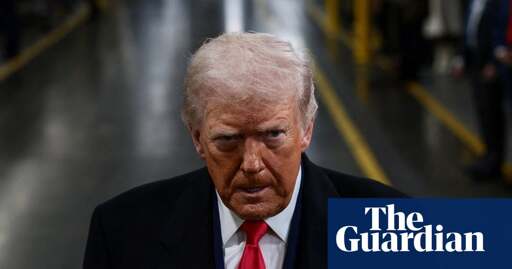
Three hundred and sixty-five days after Donald Trump placed his hand on the Bible and completed an extraordinary return to power, many historians, scholars and experts say his presidency has pushed American democracy to the brink – or beyond it.
In the first year of Trump’s second term, the democratically elected US president has moved with startling speed to consolidate authority: dismantling federal agencies, purging the civil service, firing independent watchdogs, sidelining Congress, challenging judicial rulings, deploying federal force in blue cities, stifling dissent, persecuting political enemies, targeting immigrants, scapegoating marginalized groups, ordering the capture of a foreign leader, leveraging the presidency for profit, trampling academic freedom and escalating attacks on the news media.
The scale and velocity of what he has been able to accomplish in just a year have stunned even longtime observers of authoritarian regimes, pushing the debate among academics and Americans from whether the world’s oldest continuous democracy is backsliding to whether it can still faithfully claim that distinction.
“In 2025, the United States ceased to be a full democracy in the way that Canada, Germany or even Argentina are democracies,” Steven Levitsky and Daniel Ziblatt, the prominent Harvard political scientists and authors of How Democracies Die, and the University of Toronto professor Lucan Way, wrote in Foreign Affairs last month. They argued that the US under Trump had “descended into competitive authoritarianism”, a system in which elections are held but the ruling party abuses power to stifle dissent and tilt the playing field in its favor.
I’m in the US as a failed state camp. Once the Americans can accept that position, there can be a proper rebuild.
I’d consider the label “competitive authoritarianism” as rather generous, and narrowly focused on just the internal processes of the US. I also believe that the current state of the US can be more defined once we expand the view to include the Americans have yet to fully explore the scope and extent of the Epstein files, along with the full collapse of the Supreme Court of the United States to corruption.
I have similar concerns for Canada: the lack of any check on the political party system itself. For the US, with only two functional political parties, the need for some checks is even more desperate. Originally I think the concern is that politicians are always the target of lobbying and potential bribery. They are technically the most fluid agents in the political system, and therefore one of the weakest points.
Perhaps what surprised both the Americans, and others abroad, is how there’s no check on SCOTUS Justices for what essentially amounts to the appearance of outright bribery and corruption. At that point, I would have expected a full audit of the suspect Justices cases should have been done and essentially a complete review of every case should have been committed. Maybe a temporary expansion of the number of Justices to include members of the American Bar Association and other Justice system participants should have been done to basically re-hear the compromised cases.
In any event, the damage to American institutions is far reaching, and deep. I don’t think the American public fully appreciates that even with the “frame” of what once was a democracy, the damage will probably take decades to recover from.