I don’t recall what I was reading, but I once read about a lot of things lined up perfectly for evolution on Earth.
In Sol’s habitable zone
Has a moon
Rotates on tilted axis
Stable rotation and orbit
Has magnetic field
Has Ozone Layer
Big planet (Jupiter) close enough to catch random asteroids, but not close enough to harm Earth
It’s bonkers that it all worked out that way so that I could be here, right now, reading your post and responding. It really boggles the mind and I don’t want to waste my time.
Welp, guess I’m gonna go look up random curse words in the dictionary. ಠᴗಠ
“If you imagine a puddle waking up one morning and thinking, 'This is an interesting world I find myself in — an interesting hole I find myself in — fits me rather neatly, doesn’t it? In fact it fits me staggeringly well, must have been made to have me in it!"
This is rather as if you imagine a puddle waking up one morning and thinking, ‘This is an interesting world I find myself in — an interesting hole I find myself in — fits me rather neatly, doesn’t it? In fact it fits me staggeringly well, must have been made to have me in it!’ -Douglas Adams
Lines up perfectly … for life as we know it. See also: The Anthropic Principle
But in the vastness of space, it was practically guaranteed to happen somewhere. There are a set of criteria that allow for the evolution of life (as we know it) and it was going to happen somewhere, the fact that it happened here is no more awesome than it happening 3 galaxies over.
I know the feeling you are describing and the words to describe what i am trying to say are hard for me to grasp.
Its like in a film where the hero survives seemingly impossible odds and people watching say “no way, thats impossible” and can’t enjoy the film because its too unbelievable. I say no! This is a story about the one almost impossible time all these things happened. Thats the point. Yes its hard to believe, but thats what makes it awesome.
So the earth being here and humanity and all other animals evolving here is just the time in the impossibly vast universe that the “stars aligned” and the fact that we are experiencing it is just expected.
But in the vastness of space, it was practically guaranteed to happen somewhere.
Do we know this for sure?
When we thoroughly shuffle a deck of 52 cards, we’re almost certainly creating a new deck order that has never been seen before and will likely never be seen again in a random shuffle.
The number 52! is 8 x 10^67, so large that we can make the equivalent of a billion (1 x 10^9 ) shuffles per second per person on earth (8 x 10^9 ), so that in any given millennium (3.15 x 10^10 seconds) we’ve covered a percentage so small it’s got 36 leading zeros after the decimal point for the percentage, or 38 leading zeroes for the ratio itself.
My impression is that factorial expansion for probabilities moves up much faster than the vastness of space itself, but I don’t know how to calculate the probabilities of each of these priors.
A deck of cards is actually random, whereas star, planet and solar system formation is constrained by a load of physical laws, mainly gravity. We know little about solar system formation, but sufficient to say it’s not a card deck shuffle, which is pretty much customised to be as random and unpredictable as possible. It’s counterintuitive in a way, that something as mundane as a deck of cards could be mathematically so extreme, while celestial bodies tend towards equilibrium and similar configurations, but it’s true.
By contrast, one of the most important scientific rationales of the enlightenment is the Copernican Principle, which states that humans do not have a privileged position in the universe: where we are is pretty typical. Or, at a large scale, the properties of the universe are the same for all observers.
But, in answer to your first question, no. We absolutely do not know this for sure. It’s just pretty solid reasoning.
We know little about solar system formation, but sufficient to say it’s not a card deck shuffle,
Well it’s different in several factors competing in different directions, and it’s not clear to me what the overall aggregate direction is.
The fundamental force of gravity is going to drive a lot of disparate starting points to collapse into similar results.
But in the end, we’re still talking about the probabilistic chances that certain lumpiness in the distribution of mass from supernovas or whatever forms the matter of solar systems, and how each solar system’s spinning disk coalesces into planets with their own elemental composition and orbits and rotations and moons and internal rotation and energy that might make for magnetic fields, plate tectonics, etc.
If the probabilities of those may still have some independence from one another, then even if there are lots of stars like ours and maybe even lots of planets that are earth sized, and lots of planets with the oxygen to make water or carbon to make organic chemistry or the iron to make a magnetic field, we might still recognize that the correlations between these not-fully-independent variables still require stacking probabilities on probabilities at a factorial rate.
While the number of opportunities for those conditions to hit might go up at an exponential rate, if the probabilities are small enough and there are enough necessary factors for life stacking on each other, it’s entirely possible that the exponential expansion of more solar systems than we could fathom is still too small to make for an appreciable probability of the conditions of life.
I don’t know what the probabilities actually are. But I can see how the math of the combinatorics can totally dwarf the math of the vastness of the universe, such that the overall probability remains infinitesimal.
The aggregate direction is always towards highest entropy, which means lowest energy state, stability etc. Planets tend to self organise into harmonic orbits with simple whole number ratios, because that’s the lowest energy state. But the result is that we have a nice, stable solar system where planets have relatively circular orbits with nice spacing. Despite the initial chaos of the formation, it’s very likely that all solar systems collapse into this kind of high entropy, regular stability, and what little observations we can make of other systems have confirmed it.
The point is that it’s not at all random, there are irresistible forces at play which narrow the space of what’s possible into a very small box, cosmologically speaking. Matter organises itself into spheres, then into orbits etc. We don’t see disc shaped planets for example because they’re physically impossible to make using natural processes. And we don’t see planetary collisions because they can only happen at the start, in the chaos of system formation. Then it all settles down into a stable, predictable, harmonically resonating system, as the laws of thermodynamics predict.
I’m not disagreeing with you on any of the physics of solar system formation, just disagreeing with your interpretation it means that habitable planets are high probability.
When clouds of dust and gas settle into spherical planets, what makes them rocky? What makes them have magnetic fields, atmospheres, water? What makes it so that the planet in the habitable zone hits those conditions.
The tendency of certain things to develop isn’t a lockstep correlation of 1 between these factors.
We can believe that stars are common. And so are planets. But what combination of factors is required for life, and does that combination start leveraging the math of combinatorics in a way that even billions of planets in each of trillions of galaxies wouldn’t be enough to make it likely that there are other planets that can give rise to life as we know it.
My point isn’t actually about cosmological physics. It’s a point I’m making about the math about probabilities being counterintuitive, in a way that “the vastness of the universe” doesn’t actually mean that life is inevitable. It might still be, but it doesn’t necessarily follow.
Well I didn’t specifically say habitable planets are high probability. But it just so happens that they are. Firstly consider the Copernican Principle. If we live on a habitable planet then it’s logical to make the assumption that habitable planets are common. There are strong counterpoints to this, but it’s all very hypothetical anyway so it’s better to just point to the empirical evidence: astronomers estimate that [one in five stars has an earth sized planet in the Goldilocks zone](One in Five Stars Has Earth-sized Planet in Habitable Zone – W. M. Keck Observatory https://share.google/J40L3PlVnAvee7C7B).
In terms of the why, it’s a much more difficult question to answer, but the stages of planetary formation that are proposed include processes whereby heavier elements coagulate together, earlier, and those that end up massive enough then attract lighter elements and become gas giants. Rocky planets formed close to the sun because it was hotter there and water/ice couldn’t form and contaminate the denser elements, although it doesn’t seem to happen that way in other artist systems.
Everywhere we look we see rocky planets and we see water. It’s not unlikely that rocky planets therefore would have liquid water fairly often
If we live on a habitable planet then it’s logical to make the assumption that habitable planets are common.
That’s what I take issue with. I don’t think that follows.
If I have a random deck of cards, I can’t assume that the deck order is common. Or, if I flip a coin 20 times I can’t assume that the specific heads/tails order that results is commonly encountered, either. Just because it actually happened doesn’t mean that the a priori probability of it happening was likely.
The Copernican Principle is assuming that all decks of cards or all flipped coins follow the same rules. I’m not disagreeing with that premise, but I’m showing that no matter how many decks or coins you use, the probability of any specific result may be infinitesimal even with as many decks as there are planets in the universe.
Showing me good reason to believe that earth sized planets have a 20% chance of showing up in habitable zones still doesn’t answer the other questions I have about plate tectonics, elemental composition, magnetic fields, large moons, etc. Stacking dozens of variables with conditional probabilities can still produce numbers so small that even every star in the universe representing a “try” might not lead to a high probability result.
IIRC;
Tilted axis gives us the seasons by doing so causing weather and water streams. Also lightning.
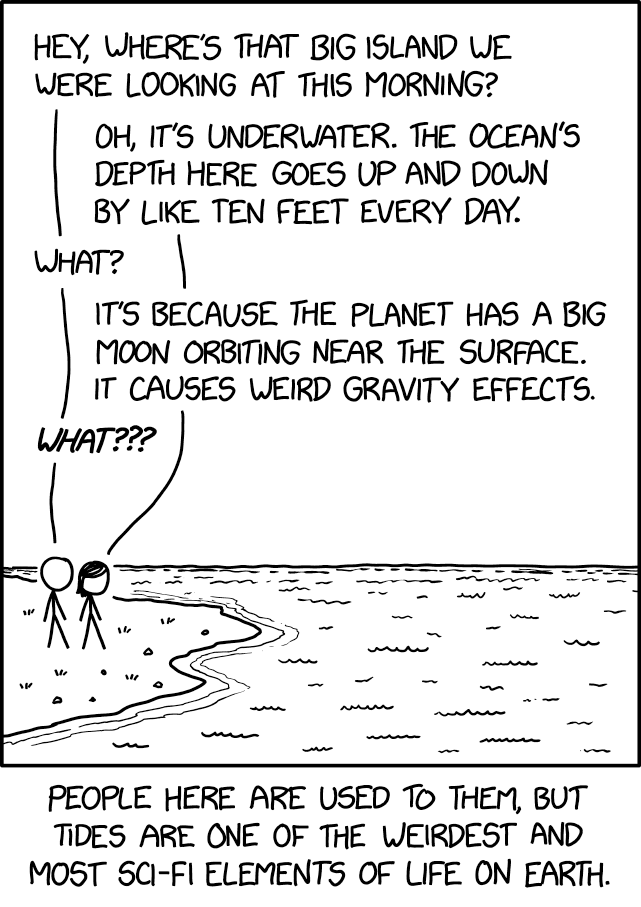
Having a moon causing the tides is what’s believed to be the reason for the chemicals in the dirt and rocks mixing well to prepare the amino acids or something similar.
The moon, due to it’s unusual size and proximity for a moon, has a much greater effect on the tides than the sun. That’s why the tides are more closely linked to the moon’s orbit around the earth, not the Earth’s around the sun.
There are a few reasons but I kind of think it boils down to biodiversity. Seasonal changes, tides, light exposure, and varying temperatures would affect the balance of diverse life.
‘lined up perfectly’ is a stretch, considering it’s safe to assume these ‘perfect’ conditions have appeared more than quadrillions of times within the universe
…and of course we’re in the darkest parts of that universe, so we will never be able to experience other similar worlds. Damn.
Oh for sure. The universe is too big for it to not have happened elsewhere. I’m not saying it’s unique, just rare.
For me, it was the fact that the Earth is tilted at just the right angle that sort of blew my mind. Too much one way or another, we wouldn’t have seasons or day/night cycles.
From under, other planets have been identified with the potential for life, but don’t have the tilt or the moon.


I don’t recall what I was reading, but I once read about a lot of things lined up perfectly for evolution on Earth.
It’s bonkers that it all worked out that way so that I could be here, right now, reading your post and responding. It really boggles the mind and I don’t want to waste my time.
Welp, guess I’m gonna go look up random curse words in the dictionary. ಠᴗಠ
Look up Douglas Adams’ puddle analogy?
“If you imagine a puddle waking up one morning and thinking, 'This is an interesting world I find myself in — an interesting hole I find myself in — fits me rather neatly, doesn’t it? In fact it fits me staggeringly well, must have been made to have me in it!"
Lines up perfectly … for life as we know it. See also: The Anthropic Principle
But in the vastness of space, it was practically guaranteed to happen somewhere. There are a set of criteria that allow for the evolution of life (as we know it) and it was going to happen somewhere, the fact that it happened here is no more awesome than it happening 3 galaxies over.
I know the feeling you are describing and the words to describe what i am trying to say are hard for me to grasp.
Its like in a film where the hero survives seemingly impossible odds and people watching say “no way, thats impossible” and can’t enjoy the film because its too unbelievable. I say no! This is a story about the one almost impossible time all these things happened. Thats the point. Yes its hard to believe, but thats what makes it awesome.
So the earth being here and humanity and all other animals evolving here is just the time in the impossibly vast universe that the “stars aligned” and the fact that we are experiencing it is just expected.
Do we know this for sure?
When we thoroughly shuffle a deck of 52 cards, we’re almost certainly creating a new deck order that has never been seen before and will likely never be seen again in a random shuffle.
The number 52! is 8 x 10^67, so large that we can make the equivalent of a billion (1 x 10^9 ) shuffles per second per person on earth (8 x 10^9 ), so that in any given millennium (3.15 x 10^10 seconds) we’ve covered a percentage so small it’s got 36 leading zeros after the decimal point for the percentage, or 38 leading zeroes for the ratio itself.
My impression is that factorial expansion for probabilities moves up much faster than the vastness of space itself, but I don’t know how to calculate the probabilities of each of these priors.
A deck of cards is actually random, whereas star, planet and solar system formation is constrained by a load of physical laws, mainly gravity. We know little about solar system formation, but sufficient to say it’s not a card deck shuffle, which is pretty much customised to be as random and unpredictable as possible. It’s counterintuitive in a way, that something as mundane as a deck of cards could be mathematically so extreme, while celestial bodies tend towards equilibrium and similar configurations, but it’s true.
By contrast, one of the most important scientific rationales of the enlightenment is the Copernican Principle, which states that humans do not have a privileged position in the universe: where we are is pretty typical. Or, at a large scale, the properties of the universe are the same for all observers.
But, in answer to your first question, no. We absolutely do not know this for sure. It’s just pretty solid reasoning.
Well it’s different in several factors competing in different directions, and it’s not clear to me what the overall aggregate direction is.
The fundamental force of gravity is going to drive a lot of disparate starting points to collapse into similar results.
But in the end, we’re still talking about the probabilistic chances that certain lumpiness in the distribution of mass from supernovas or whatever forms the matter of solar systems, and how each solar system’s spinning disk coalesces into planets with their own elemental composition and orbits and rotations and moons and internal rotation and energy that might make for magnetic fields, plate tectonics, etc.
If the probabilities of those may still have some independence from one another, then even if there are lots of stars like ours and maybe even lots of planets that are earth sized, and lots of planets with the oxygen to make water or carbon to make organic chemistry or the iron to make a magnetic field, we might still recognize that the correlations between these not-fully-independent variables still require stacking probabilities on probabilities at a factorial rate.
While the number of opportunities for those conditions to hit might go up at an exponential rate, if the probabilities are small enough and there are enough necessary factors for life stacking on each other, it’s entirely possible that the exponential expansion of more solar systems than we could fathom is still too small to make for an appreciable probability of the conditions of life.
I don’t know what the probabilities actually are. But I can see how the math of the combinatorics can totally dwarf the math of the vastness of the universe, such that the overall probability remains infinitesimal.
The aggregate direction is always towards highest entropy, which means lowest energy state, stability etc. Planets tend to self organise into harmonic orbits with simple whole number ratios, because that’s the lowest energy state. But the result is that we have a nice, stable solar system where planets have relatively circular orbits with nice spacing. Despite the initial chaos of the formation, it’s very likely that all solar systems collapse into this kind of high entropy, regular stability, and what little observations we can make of other systems have confirmed it.
The point is that it’s not at all random, there are irresistible forces at play which narrow the space of what’s possible into a very small box, cosmologically speaking. Matter organises itself into spheres, then into orbits etc. We don’t see disc shaped planets for example because they’re physically impossible to make using natural processes. And we don’t see planetary collisions because they can only happen at the start, in the chaos of system formation. Then it all settles down into a stable, predictable, harmonically resonating system, as the laws of thermodynamics predict.
I’m not disagreeing with you on any of the physics of solar system formation, just disagreeing with your interpretation it means that habitable planets are high probability.
When clouds of dust and gas settle into spherical planets, what makes them rocky? What makes them have magnetic fields, atmospheres, water? What makes it so that the planet in the habitable zone hits those conditions.
The tendency of certain things to develop isn’t a lockstep correlation of 1 between these factors.
We can believe that stars are common. And so are planets. But what combination of factors is required for life, and does that combination start leveraging the math of combinatorics in a way that even billions of planets in each of trillions of galaxies wouldn’t be enough to make it likely that there are other planets that can give rise to life as we know it.
My point isn’t actually about cosmological physics. It’s a point I’m making about the math about probabilities being counterintuitive, in a way that “the vastness of the universe” doesn’t actually mean that life is inevitable. It might still be, but it doesn’t necessarily follow.
Well I didn’t specifically say habitable planets are high probability. But it just so happens that they are. Firstly consider the Copernican Principle. If we live on a habitable planet then it’s logical to make the assumption that habitable planets are common. There are strong counterpoints to this, but it’s all very hypothetical anyway so it’s better to just point to the empirical evidence: astronomers estimate that [one in five stars has an earth sized planet in the Goldilocks zone](One in Five Stars Has Earth-sized Planet in Habitable Zone – W. M. Keck Observatory https://share.google/J40L3PlVnAvee7C7B). In terms of the why, it’s a much more difficult question to answer, but the stages of planetary formation that are proposed include processes whereby heavier elements coagulate together, earlier, and those that end up massive enough then attract lighter elements and become gas giants. Rocky planets formed close to the sun because it was hotter there and water/ice couldn’t form and contaminate the denser elements, although it doesn’t seem to happen that way in other artist systems.
Everywhere we look we see rocky planets and we see water. It’s not unlikely that rocky planets therefore would have liquid water fairly often
That’s what I take issue with. I don’t think that follows.
If I have a random deck of cards, I can’t assume that the deck order is common. Or, if I flip a coin 20 times I can’t assume that the specific heads/tails order that results is commonly encountered, either. Just because it actually happened doesn’t mean that the a priori probability of it happening was likely.
The Copernican Principle is assuming that all decks of cards or all flipped coins follow the same rules. I’m not disagreeing with that premise, but I’m showing that no matter how many decks or coins you use, the probability of any specific result may be infinitesimal even with as many decks as there are planets in the universe.
Showing me good reason to believe that earth sized planets have a 20% chance of showing up in habitable zones still doesn’t answer the other questions I have about plate tectonics, elemental composition, magnetic fields, large moons, etc. Stacking dozens of variables with conditional probabilities can still produce numbers so small that even every star in the universe representing a “try” might not lead to a high probability result.
Some people are bad at shuffling though. It’s not like they actually randomize the deck perfectly each time.
So bad that bridge players see a perfect deal like once a decade. It often makes the news.
How does having a moon and the tilted axis contribute to evolution?
IIRC; Tilted axis gives us the seasons by doing so causing weather and water streams. Also lightning. Having a moon causing the tides is what’s believed to be the reason for the chemicals in the dirt and rocks mixing well to prepare the amino acids or something similar.
Thank you for the explanation.
Our moon is not the only reason for the tides existing, our Sun kinda also have gravity, so it causes tides too.
The moon, due to it’s unusual size and proximity for a moon, has a much greater effect on the tides than the sun. That’s why the tides are more closely linked to the moon’s orbit around the earth, not the Earth’s around the sun.
They are linked to both though. That is why you get even higher tides at some times of the year. The moon has a larger effect but they can combine.
There are a few reasons but I kind of think it boils down to biodiversity. Seasonal changes, tides, light exposure, and varying temperatures would affect the balance of diverse life.
For example, Earth didn’t always have oxygen. 2.4 billion years ago there was a bunch of microbial photosynthesis happening. Seasons and the tides affect ocean currents which moved nutrients around, allowing the bacteria to thrive and grow.
Ozone’s formula is O3, so the Ozone layer wouldn’t have formed either.
There are also other issues like how the seasons affect biological migration or how the moon slows the Earth’s rotation to about 24 hours/day.
Seasons add variability, which helps select life that is adaptable and less likely to be wiped out.
Moon keeps the ocean moving, circulating the oxygen and nutrients.
Thank you for the explanation.
‘lined up perfectly’ is a stretch, considering it’s safe to assume these ‘perfect’ conditions have appeared more than quadrillions of times within the universe
…and of course we’re in the darkest parts of that universe, so we will never be able to experience other similar worlds. Damn.
Oh for sure. The universe is too big for it to not have happened elsewhere. I’m not saying it’s unique, just rare.
For me, it was the fact that the Earth is tilted at just the right angle that sort of blew my mind. Too much one way or another, we wouldn’t have seasons or day/night cycles.
From under, other planets have been identified with the potential for life, but don’t have the tilt or the moon.
The sole fact that we’re here means that we don’t even have to think about those, but yeah.