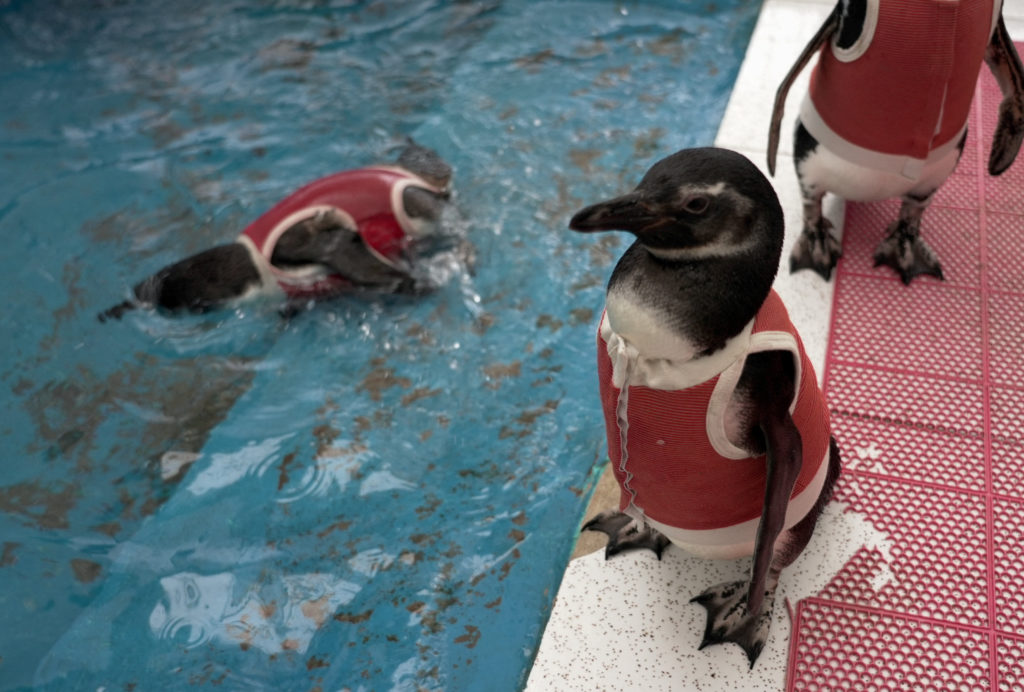
These penguins are wearing actual penguin suits, but they’re more about the substance than style. Penguins are facing planetary perils, and these special vests are designed to help.
In Chile, injured penguins are swimming, eating, and shimmying in them. The cocoon of red fabric is woven with healing minerals, copper, which helps prevent bacteria and fungi from growing, and zinc, which encourages new blood vessels to form. Together, they can repair damaged tissue more quickly.
It’s chainmail, right? I want to believe they’re being altruistic, but if a group starts armoring many flightless birds, you just know The Penguin’s behind it.
Well, alright.

When am I ever going to get the perfect moment to show off this little dude again?
every moment is a good moment to show off lil dude
Wow. I love him! 🤩
Thanks!
I don’t recall what kind of plushie he is. I can check the tag later. I knitted the chainmail years ago. Yes, it’s real – for a given value of real. It’s made of stainless steel wire.
Please check the tag hes so cute
It turns out he is a Chinese knockoff. The tag is worn and not all of it is legible:
?? Tian Hsing International Trading Co., Ltd.
?? Industry Zone, Changzhen ??ngming Town, Baoan District
Art. No. PA-12457(CN)
…And then materials and warnings. 100% polyester, don’t you know. It’s no good searching that article number, either, because it turns up exhaust pipes and not penguins. Go figure.
Not necessarily, copper fibers can be woven if they’re thin enough. They’re sometimes used in ESD gloves (electro-static discharge, for working with sensitive electronic components)
That is cool, this is off subject but here is another animal in clothes.

Tac-Dog is cool 😎
I wonder if the dog is confused that everything looks dark
I would assume after its pupils dilate it gets used to it. I know I do, and then if I take off my glasses I’m “blinded by the light”
“Wrapped up like a douche, another boner in the night”
They look adorable!
https://www.youtube.com/watch?v=e6tJZx_KxSw
The penguins will gain access to pickles, and the powers of Brett Farrrvurrr.
How does zinc encourage new blood vessels to form?
I’m not sure if that’s overstated, it’s news to me too. I’m aware of zinc as a skin-healing treatment, and it has a vasodilation effect through (I believe) topical application, so perhaps that’s being mis-stated (or that lends credence to promoting growth).
I did find this from a quick search.
The rabbit hole beckons - off I go.
Copper is a well-known anti-microbial.
In Orlando, they built the Dr Philips Performing Arts Center, and the handrails on the steps are all copper pipes, to control microbes. I noticed it the first time I went there, and thought it was a great idea.
I was going to suggest they do it in the NYC subways, but the crackheads would steal the cooper rails within minutes of installation.
That’s why old fashioned door handles are brass: it has similar qualities (which people realized wayyyyyy before germ theory).
I’m pretty sure brass was used because it was durable and stayed smooth to the touch in the elements unlike wrought iron, I don’t think they were trying to prevent the spread of disease
I wish the history of regular household stuff was better recorded
Copper and silver both. We need more unvarnished brass doorknobs in our lives!
But Kwikset has Microban™ coating on their doorknobs! Surely you would rather have a thin layer of chemical coating that totally won’t come off and give you cancer and the production of which absolutely doesn’t poison fresh water. Why do you want giant corporations to have to spend extra money making doorknobs out of brass when they can use aluminum alloys, white-metal, dog leavings, and snot instead?
(I have no evidence Microban™ uses carcinogenic products, nor that its production pollutes the environment. I only have *gestures broadly at 300 years of industrialization and its affects* all of that)
IIRC Microban and related treatments work by coating the surface in nano sized spikes that puncture bacteria’s cell walls on contact. But the stuff is apparently not just one product, rather a range of products all lumped under that name with various compositions depending on what kind of surface they’re intended to be applied to. Sometimes the little nano-teefies do indeed contain silver.
I want healing socks too!
Next Die Hard installment?