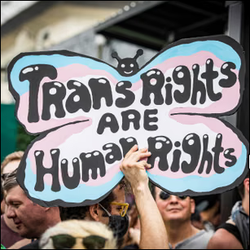


A federal appellate court ruled last week that Oregon may house trans women inmates in men’s prisons, overturning a lower court’s ruling earlier this year.
The three-judge panel of the 9th Circuit Court of Appeals consisted exclusively of Donald Trump appointees. They voted unanimously to overturn an April ruling from U.S. Magistrate Judge Mark D. Clarke ordering the Oregon Department of Corrections to assume that trans women prisoners should be housed in women’s prisons, and then assess individual cases to confirm that placement, not the other way around.
How so? Could you point at a social behavior in another animal that you’d evaluate as arising from something other than nature? Not saying you’re wrong, just curious.
When people use the word “nature” in this context, it evokes (intentionally or otherwise) the dichotomy of nature vs. nurture, where nature tends to refer to innate traits that would exist regardless of upbringing or social experiences. From that lens, most social behaviours in animals would be better understood as being a result of “nurture”. An amusing example from my own life is that I used to have a dog that had spent its entire life around cats after being found as an extremely young puppy. The sounds he made when begging for attention were like nothing I had ever heard from a dog before, because he was trying to emulate the cat sounds.
I get why you’re confused though, because the line between nature and nurture is fuzzy at best. Indeed, this is why the scientific consensus on the matter is that rather than “nature vs. nurture”, it’s better to think of it as “nature via nurture”, where nature and nurture are constantly in dialogue with each other, and can’t really exist separate from each other. An example of “nature via nurture” might be if someone was genetically predisposed to be extremely tall, but they experienced significant malnourishment throughout their life — they probably wouldn’t end up being tall