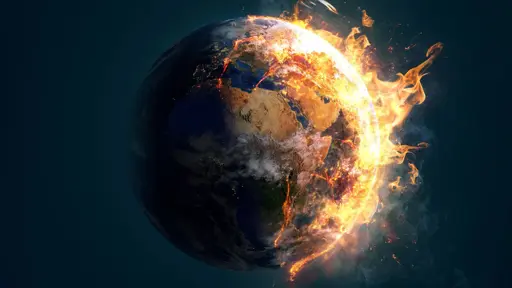
Global warming appears to have shifted into a faster gear. After removing the effects of El Niño, volcanic eruptions, and solar cycles, researchers found that the planet has warmed at roughly 0.35°C per decade over the past ten years, compared with just under 0.2°C per decade from 1970 to 2015. The acceleration, which becomes visible around 2013 to 2015, appeared across five major global temperature datasets with more than 98% statistical certainty.


I’ve read that the models used to predict the rate of change were too optimistic or an assumption about them was too conservative and thus not very realistic. Now we have data showing the models under-predicted the rate of change, so one argument is that we were already on this path since decades ago, we just didn’t model it right.
In any case, we’re all fucked so who gives a shit anyway no?
Is there a name for when we know what the right thing to do is but we keep not doing it?
Hubris.
Great Filter.
No way in hell we’re facing an extinction event. Unimaginable human suffering, probably, but humanity will persist.
Isolated pockets in relatively protected areas. Global society won’t survive it. Most of the places we grow food won’t be able to grow food, that’s already accelerating. Ocean acidification kills that food source. Blue ocean event accelerates runaway heating leading to massive hurricane force continental storms. Amoc shuts down and Europe ices over. Humanity may persist but civilization won’t.
Vast current areas become arid but vast areas in Siberia and Canada become arable. Very bad but not extinction for humans. Likely extinction for many species though.
None of that thawed soil will be worth a damn for growing at any scale. Like yeah there will be areas that are more or less hospitable but large scale agriculture will not recover
We are driving 200 species extinct a day and that figure is increasing every year. Eventually we run out of nature and we go with it.
The temperature on the planet has never in its history changed so abruptly, which means plants and animals don’t have enough time to adapt.
that’s also not true! vast current areas become
aridtropical. see the tropical rainforest. it’s the hottest and simultaneously wettest regions on earth.Yes, that’s what I said
that’s just not true! higher temperature makes food grow better, not worse.
Not if it includes lots and lots of drought. Besides of course that lots of the now commonly used crops definitely have an upper limit where heat is beneficial.
yeah but typically, the hottest regions on earth (tropical rain forest, directly on the equator) are also the wettest regions on earth at the same time.
that the sahara and arizona are dry, has nothing to do with the solar irradiation itself, but instead with the wind patterns.
We are adaptable creatures with command of technology. So we’ve got that going for us. We also have temperature limitations in which we can live, and so do our food sources. Then there’s the issue of potable water.
It really depends on how far we’re pushed the planet’s ecosphere. It could do like before (most recent is the PETM) and hover high, then eventually equalize back into something not the same as we had, but similar. It’s done this before, albeit after millions of years. Or it could find a new equilibrium in another state, aka hothouse. Not Venus-like, as some media has spun it, but its own version of feedback to retain a lot more heat than now. Not great for anything that evolved in this climate.
Fun fact: the PETM was the most recent heating event, 56 million years ago. Some species went extinct, others were able to adapt and survive as they evolved into smaller forms. The fun fact is that they adapted because the rate of heating change was over a large amount of time, many hundreds of thousands of years. Now look at us, a spike on the geological temperature graph in (looks at data) less than a 100 years (a few decades, really). So what kind of inertia does a more rapid acceleration usually give compared to a slower one? But hothouse Earth is just a speculation, just a guess. We don’t know how far this will go.
Really depends on what happens with phytoplankton; if they can adapt well enough to survive the excessive heat. Some of them can but others are dying out. If we lose all of them, then everything that breaths oxygen is extremely fucked since they make ~70-80% of that oxygen. Then we only have plants and forests like the amazon to make O2 (and we all know how that ones going), and then we would also have to deal with the gasses produced by all the oceans on the face of the earth dying and everything in them rotting… if they’re not par-boiled.
The Great Filter doesn’t necessarily mean we need to go extinct as a species. Destroying our capability of advanced technology is enough. Which it certainly will.
But will that subsequent civilization get to space again?
I’ve often wondered… What if we are way wrong about the level of danger, and ultimately climate change will turn Earth into another Venus, and we only find out once it’s too late?
History has taught that humanity wont stop until it has gone too far.
All of the climate models have adjustable parameters. We are still within the bounds of the worst case scenarios but scientists are always afraid to claim too much. An academic’s reputation is a lot less recoverable than a pop star or politician in the sense that they, and their colleagues, actually take their words and predictions seriously. I don’t want to completely dismiss the effect of lobbying and corruption toward the downplaying of global warming, but making smaller-than-necessary claims is a common sight in most academic fields.
I think it’s mostly in fields with exponential outcomes, which experiences the too conservative estimates.
We as a species has a really hard time understanding exponential/accelerant movement, we expect the next decade to change as much as the previous one. Despite every decade has been changing more than the previous one did