I have been using Linux for over 8 months now, and my primary distribution of choice was Debian.
Debian recently conducted a community vote on allowing AI contributions, and it ended up allowing responsible AI contributions.
What is this responsible? How can AI commits be responsible? There are thousands of reasons to not use AI, and the primary reason is AI is a thief.
How did you react to Debian’s decision? Did you switch distros? Which one was your option, and why?
Also, when the Linux kernel itself allows AI commits, is there any practicality in a Linux distribution strictly limiting or restricting AI commits?
I have no serious usability issue with Debian now but am concerned about the use of AI even in my Linux distribution. Should I keep going with Debian or consider any other distribution, as I only have 8+ months of experience as a daily Linux user? I tried almost all Linux distros and am comfortable with everything except Void Linux and highly complex ones like Gentoo.
There are a few distros that do reject all AI code, which you can find in these two lists:
https://noai.starlightnet.work/list.html
https://codeberg.org/ethical-foss/open-slopware#linux-based (under the ‘Alternative Linux-based operating systems’ section).
Are Anti-AI Linux distributions practical?
It’s not possible to have a 100% no-LLM-coding-involved Linux distro anymore now that the kernel itself is welcoming LLM-assisted contributions, but it’s still possible to say that everything which the distro produces itself will not use AI.
How can AI commits be responsible?
What Debian means is: by reading what it produces and not just blindly accepting it but having humans review it carefully. The quality of LLM-assisted software is highly variable. Experienced people like Debian and Linux kernel developers are much less likely to publish very bad slop than inexperienced developers who are newly able to make a thing work well enough to ship it.
I am concerned about the extent of Debian’s embrace of LLMs but I still have a lot more confidence in them than most other distros (especially small hardcore-anti-AI distro projects lacking sufficient developer capacity to even keep up with security updates).
I expect we’ll be seeing lots more things like this non-upstreamable-because-AI hardware enablement and distros like Nura (formerly postmarketOS) will either either adopt more nuanced LLM policies or be forked.
I am doubtful about if there will be any serious distros with hard LLM bans in a few years from now. But also, perhaps the bubble will have burst by then, so hosted inference won’t be so cheap and the use of LLMs will probably be quite different.
the primary reason is AI is a thief
This is not the primary reason for most people, I don’t think. I think the fact that it increases complexity while reducing human understanding is the biggest problem; it’s possible (easy even) now to produce mountains of good-enough-by-many-metrics source code which the person doing the prompting has very little comprehension of. The fact that it is also a plagiarism machine is far less of a problem than this. (There are a litany of other problems too of course, several others of which I would also rate as worse than the plagiarism aspect.)
OpenBSD.
Come learn about computo.
Be free with us.
Also, when the Linux kernel itself allows AI commits, is there any practicality in a Linux distribution strictly limiting or restricting AI commits?
Upstream is unrestricted, unless you want to detach from upstream it’s hopeless.
thief
If you advocate for further expansion of “copyright” oppression, you deserve microsoft windows.
This. So much.
I am old enough to remember many people on the Internet questioning the entire concept of copyright and reacting to it with free licensing, defense of torrent sites, founding Pirate Parties.
Now I read that the primary reason to reject AI is that it is a “thief”??? In the era I described above, someone wrote a song with the lyrics: copying is not theft, stealing a thing leaves one less left, copying it makes one thing more, that’s what copying’s for…
Copyleft is a hack of copyright that ensures rights to users of software that you wouldn’t have if there was no copyright. Software is different from other creative works like music and books in that it does computing. Sharing a binary file freely isn’t enough - you need the source code to keep it maintained or change it to your will (through collaborative efforts). You prevent others withholding the source code via that copyrighted license.
You can reject the unreasonable sentences of copyright infringement, the illegality of breaking locks on your own hardware, or the long copyright terms while still promoting copyright for copyleft’s sake. Companies lobbies for those laws to prevent "stealing’, throwing people in jail or fining them into oblivion - are they going to undo all that? Can I share Disney films without going to jail now?
while still promoting copyright for copyleft’s sake.
What the hell.
Copyleft means “the absence of copyright”, not “copyright wielded by radlibs”.
Copying… is fuuuuuuuuun 🎶🎵
GPL may call itself “copyleft”, but legally it is dependent on copyright to be enforceable. In the first place, the whole point of licenses like GPL is to ensure that when people take from the commons, they also give back to the commons. The way AI gains its ability to generate shitty code undermines this, and so is ideologically very much at odds with Linux and the wider FOSS world.
Copyright is a deprivation of freedom, and the GPL comes using this rules to turn around them. I won’t defend copyright. AI comes with more important problems, such as ecology, and creating monster private companies that have far too much power.
The tool in itself can really be usefull when well used. Many people use it and get nice results. Many people abuse it, and many people abuse themselves with it. It is true with a hammer too. I don’t think “hammer-free” is a feature, even if their are many domain in which I don’t see the point of using a hammer (and so “made with a hammer” isn’t a feature either).
Also, I can’t find any example in history of a technology that was successfully banned despite being usefull. Some have been regulated, such as nuclear industries, but that was not perfect and needed a continuous and hard strugle. The strict “no-AI” movement has already lost its battle, at most we could get regulations, maybe…
The thing is, if all other things remain the same, an absence of copyright will also be used by the wealthy and powerful to further enrich and empower themselves and as a tool of oppression.
From the Ferengi Rules of Acquisition:
#34 War is good for business.
#35 Peace is good for business.
You cannot have internally consistent, principled view on copyright without also having a compatible view on the economy. And even then, the economy needs to come first; you cannot start destroying load-bearing pillars, no matter how ugly, without first getting everyone out of the house.
The tool in itself can really be usefull when well used. Many people use it and get nice results.
The way I see it, there are two kinds of people: those to whom AI is utterly useless because it just ends up taking more time and have them burn through their cognitive endurance faster, and those to whom it would be irresponsible to let them use it, because it would prevent them from finding better solutions for the busywork they’re letting the AI do, and they just end up creating a lot of needless maintenance overhead.
But more importantly, being “useful” to certain individuals is not the same as being good for society. Which brings us back to it undermining licenses like the GPL, which would further enrich and empower the already advantaged.
Also, I can’t find any example in history of a technology that was successfully banned despite being usefull.
CFCs? Asbestos? The bans on them aren’t perfectly enforced, but nevertheless, the hole in the ozone layer is shrinking and the number of people dying of asbestos-related lung cancer is reducing, so they do have value.
The strict “no-AI” movement has already lost its battle
Even if it were true, that would be no reason to stop trying or to stop saying the truth: No matter useful you experience it as being, you are causing harm. To yourself, to the field, to society.
GPL wields the copyright system against itself, like a virus. The goal is the complete destruction of the copyright system and the liberation of all software.
It won’t exactly be able to accomplish anything like that if it’s been undermined no matter what the mechanism of its enforcement is.
This is the GPL’s trap card. When it gets undermined, the “copyright” system loses its credibility.
That was the idea, at least. Seems like there’s people who double down on their belief in copyright in response. But that’s their own fault.
The usual saying applies: “It’s easier for them to imagine the end of the world, than the end of
capitalismthe copyright system.”
GPL (and copyleft generally) gets way more attention than it should. In the wild, MIT and similar permissive licenses are by far the most common. Linux is on GPL, but that may be a historical artifact as much as anything. I don’t know if Linus himself would choose it if he were making the choice today.
The wider FOSS community, in my experience, leans permissive rather than copyleft. The copyleft people are just loud.
EDIT: To be clear, when I say I don’t know what choice Linus would make today, I don’t mean that I’m skeptical he’d choose GPL. I literally just mean that I don’t know. He’s been quite clear that he’s not a principled believer in copyleft, but it does have real advantages for a project like the Linux kernel.
Void isn’t too difficult and is documented well.
I strongly dislike AI but am not a purist. Linux is already a no-go for purists and good luck with the alternatives.
I think the kernel’s policy on AI use is reasonable. As long as a distro or a package isn’t obvious slop and they have a clear policy, I’m okay using it or continuing to use it.
In the meantime, while I mostly use mainstream distros like Fedora and Arch, I’m quite happy that distros like Void exist so that if mainstream Linux ever takes a direction I disagree with, I have alternatives.
In the end, keep perspective. A distribution like Debian allowing for responsible AI use is not the same as the vibe-coded slop that is Omarchy.
documented well.
I’m gonna disagree on this point, I tried Void both on a VM and a spare SSD and I found the documentation was lacking. Or in the case of getting pipewire working I had to go to Reddit to find a workaround as none of the official ways to set it up worked on my systems. And it was far from the last time I had to find an undocumented solution to an issue I was facing.
I really like the idea of a completely independent distro purpose built instead of just “scraping the mold off” existing distros. But I had enough headaches with Void that I ended up on Artix, which mostly has worked out the same as Endeavour/Arch which I was using previously.
Hopefully I can try again in the future and have a better time, since I do applaud the developers for multiple reasons.
Just try to install it and use it for 1 week, and then you know the pain.
Today I tried VoidLinux once again, and after hours of trying to enable audio, I failed and finally built Arch from root. 😐
There will never be an AI free Linux distro again since it’s allowed in the kernel. I would certainly prefer to use a distro that doesn’t allow vibe coded programs though. That junk is unmaintainable and will be abandoned when the creator can no longer afford the tokens.
Most slopcode projects are abandoned and deleted within months of release – “Of the 120 unique repos, 32 were maintained and 88 were abandoned.”
maybe that could be because people do a small project then get bored and doesn’t apply to something like kernels?
Let’s see if the Kernel is abandoned in a few months, seems likely
I’ve been using Debian for a long time and honestly, I’m not going to worry about this too much as of today. We got that decision, yes. But I don’t think I’ve seen any consequences, yet. And I always try to judge people by what they actually do. Less so by what they say.
I say that the last word hasn’t been said yet. On this whole AI thing. We still got many Linux people who don’t really appreciate AI. The entire community isn’t really fond of it. We got people who say there isn’t a way to make use of it responsibly. I have a hunch there’s more to this story. But only time will tell. Until then I’m going to continue using Debian, just like I have for the past 10-15 years. I trust the community distributions, they faced other challenges before. And usually they’re not half bad at facing challenges and ultimately doing the right thing.
Doesn’t have to be easy. Sometimes we’re headed the wrong direction for a while. But what matters IMO is the result. And I’m positive they’ll find some way to deal with this. I don’t think AI fits Debian’s identity at all. Would be a big surprise to me if they don’t realize it as well.
What is this responsible? How can AI commits be responsible? There are thousands of reasons to not use AI, and the primary reason is AI is a thief.
I feel like you aren’t actually asking a legitimate question and are just trying to soapbox, but this is covered by Debian here: https://lists.debian.org/debian-devel-announce/2026/08/msg00005.html
As far as what the consequences of failing to follow that policy is, it would be covered under the Debian code of conduct: https://www.debian.org/code_of_conduct_interpretation.html
NOTE: I am not a Debian user. I just performed a basic search to find the answer to that question.
“How did you react to Debian’s decision?”
I deleted it, debian was thankfully not my main, just a backup/something of interest.
The ‘vote’ itself seemed dodgy, every option was going to ai in some form, or another.
AI is a tool. You already trust the developers to build an operating system with the tools available.
From the Debian announcement
The Debian Project nevertheless expects that all contributions submitted to Debian, regardless of how and with which tools they were produced, satisfy the same standards of quality, correctness, maintainability, and legal compliance. The use of a generative AI tool does not diminish the contributor’s responsibility for the work they submit. Contributors are expected to understand, review, test, and, where appropriate, modify AI-assisted output before incorporating it into Debian. Blindly accepting or uploading AI-generated material without appropriate human review is inconsistent with Debian’s established development practices.
It’s quite clear they don’t allow vibe coding. As you say, the kernal itself allows AI contributions in a similar way.
If you’re worried about the ethical aspects of AI then you’ll probably have to move to NetBSD. If you’re only worried about quality this is a non issue.
Trust is 3 parts; authenticity, competance and empathy. Trust is broken if any of those are insufficient.
If others believe AI creation and AI use hurts people then leaving that unaddressed makes one appear to lack empathy.
“Quality of code” ultimately boils down to judging how it may effect people (reading it, changing it, using the software it compiles to). To worry about code quality is only to care about people. Only caring sometimes is inconsistent - it questions their character.
You make good points however you can’t stop a person doing something because it goes against your beliefs.
In this case the Debian developers had a vote and the majority agreed that using AI was ok.
I’ve read the post and they still have a code of conduct, they still have standards that they will keep. That’s good enough for me to continue trusting the devs.
There are 2 tools to stop someone from harming others: words or violence. If people disagree an action being harmful to others then we aught to use our words to discover who’s belief better represents reality.
I think using AI to write software could be okay but the AI in use today isn’t. AI makers circumvent our social licenses and redistribute our code covertly through a mathematical blender. Debian OS authors agreed that there are legal unknowns regarding the copyrightability of generated code and didn’t say AI was okay or bad one way or the other. Debain should already know today’s AI spits at our faces.
I’m not disputing that AI has severe issues. I think it’s more appropriate for governments to focus on effective regulation than open source developers disallowing useful tools.
It might be a tool, but it is naïve not take all of its externalities into account.
From tante’s piece:
Usefulness is not an objective, fully abstract property: A thing is not useful for everyone or in general but mostly just for specific people in specific contexts. And useful never comes for free.
But let’s take a step back and use a different example: Child labor. Child labor is very “useful” if you want cheap labor. It’s 100% deplorable to use it or accept it.
Edit: a good source of said externalities: https://codeberg.org/ethical-foss/open-slopware/src/branch/main/why_not_llms.md
Is using AI as bad as child labour?
I don’t believe so. But i don’t believe in copyright laws either. If a developer chooses to use AI it’s their choice.
Obviously best case scenario is they use a local open weights model. I believe this will be more commonplace in a few years.
I think a skilled developer using AI to improve open source software is a case of the ends justifying the means.
Edit: the link you provided highlights the problems with large capitalist corporations owning the compute power and generic AI use by the untrained population more than the issue of skilled developers contributing to open source software.
While these things are a problem i don’t believe a distro should stop contributions just because a developer consulted an LLM.
Analogies are comparisons of structure, not intensity. There are a lot of things that are “not as bad” as child labour, that doesn’t make them OK.
But i don’t believe in copyright laws either. Do you believe in the goals of the GPL? Because you have to admit, the way AI works, regardless of whether you frame it as “theft” or “copyright infringement” or not, is at odds with those goals.
GPL is a response to copyright laws. If there were no copyright laws we wouldn’t need GPL.
Prohibiton doesn’t work. Regulations need to passed by government bodies not open source developers.
You do realise that even if copyright were abolished, large, powerful corporations would continue to exist and even manage to use the absence of copyright to their advantage?
Without the GPL being enforced, a company like Microsoft could finally start digging a moat around Linux without constraints.
Sure but why?
the primary reason is AI is a thief.
That’s the least important reason to not use AI. All property is theft, especially copyright!
There is a difference between people using AI to help write/maintain code that they understand, and slopcoding unmaintainable vibe projects.
I think it’s a bit the other way around. GNU, Linux and the Free Software community are very much about this copyright thing. We know it’s not right to do it like the other big companies so we try to make an effort here to make it not weigh down on the users or have the people steal, or abuse their power?!
No, you miss the point. GPL is not a feelgood license. It is a license that tries to make the licensed piece of work better by exploiting the fact that the more it is used, the more it is likely that someone can improve it for everybody. So large corporations will contribute back their tweaks and everyone profits.
It is not some kind of utopic hack
I can’t tell whether that’s supposed to be opinion or a factual matter.
What I can say, though, is: it is some sort of utopia for me. It enables me as a user to run my own independant “cloud” services, my own social media. I get to use CAD software for free which my university used to pay some 5-digit sum for, I can have a random light show in my living room, “hack” all sorts of devices and command them to do whatever I like them to do. And a bunch of really useful stuff.
And then it also made me understand computers, learn programming… It’s transparent and I can look inside. And I’m fairly sure it’s part of who I am today, I probably wouldn’t have studied CS if it weren’t for Free Software and all the stuff it enabled me to do as a teenager.
And that wasn’t just to force big companies to do something… The community made a big effort to welcome me, gift me stuff, teach me stuff and we even had quite some parties and user meetings and those morals and the motivation to change the world really stuck with me.
So I got hacked and I believe in some utopia. I’m currently living it, at least for personal stuff, and to the extent we get to be free in the modern world with all its apps, spying, and tightening down things. And I’m probably not the only one.
That all is good and lovely. My point is that this is a side benefit of having an awesome community and most people when given the choice will help someone rather than gatekeep.
The main purpose of the license is exactly the one that is forcing facebook to contribute back to the kernel, because they want the enourmous firepower of all other competitors work, and would like that their own is easy to keep with future upgrades, so they contribute not only because they are forced, but because tit is the most efficient way for them to get what modifications they need integrated properly. 40 years of this gave us the current kernel.
So if ai tools help this process they will be used, regardless of how they work morally. Because most contributors to the code are developers payed by corporations.
https://www.debian.org/vote/2026/vote_002#texte
The Debian Project nevertheless expects that all contributions submitted to Debian, regardless of how and with which tools they were produced, satisfy the same standards of quality, correctness, maintainability, and legal compliance. The use of a generative AI tool does not diminish the contributor’s responsibility for the work they submit. Contributors are expected to understand, review, test, and, where appropriate, modify AI-assisted output before incorporating it into Debian. Blindly accepting or uploading AI-generated material without appropriate human review is inconsistent with Debian’s established development practices. We enourage [sic] our contributors to disclose whether a contribution was made with AI assitance[sic], but do not require them to do so.
Most of it comes down to personally mitigating the damages:
- start with ElementaryOS and Pantheon/Gnome, then decide which path you want to follow
- if you’re hardcore, go for NetBSD or MirBSD or 9front/Plan9 instead of Linux
- on the Linux side: ElementaryOS, Gentoo, Chimera Linux, AerynOS, and Nura/PostmarketOS all have strong LLM policies
- along those lines: Gnome and Cosmic haven’t gone soft on AI the way KDE has
- Starlight Network No-AI List is one jumping off point, but there are several other lists including repo-slopscore and Weird Little Guys
Weird little guys is an interesting read, I was surprised to find Jeff Geerling there, I always thought he was just a really crappy youtuber, with really stupid fans. I was half expecting to find Linus SebastiDouche on the list afterwards.
I liked him a lot. I first learned about Jellyfin from his video just a few years ago. I would’ve bet money that Linus TT would be on such a list before Jeff Geerling. I don’t have a parasocial relationship or idolize YouTubers, but I’m definitely still disappointed. (Maybe I was a stupid fan, but now I’m just stupid 💀)
I do like Jeff’s videos, he comes across as a true engineering nerd. I find his SBC reviews to be pretty thorough and some of his other videos make for an interesting side quest on stuff he’s interested in.
I certainly don’t view DeVaults purity list as the authority on if I should watch someone’s videos or not.
Jeff never made sense to me, his videos seemed dodgy, the first one I saw he was jumping on the linus screwdriver silly hype train, but his fans just adored him, to the point I assumed some of them were drooling. I didn’t see much more of him over the years, so my view is definitely limited.
His video on the screwdriver was like the only one of it that (at least at the time) tried to actually compare it with others and not just say it’s amazing like all of the other YouTubers were doing at that time, but obviously, those ones were sponsored, jeffs wasn’t (iirc)
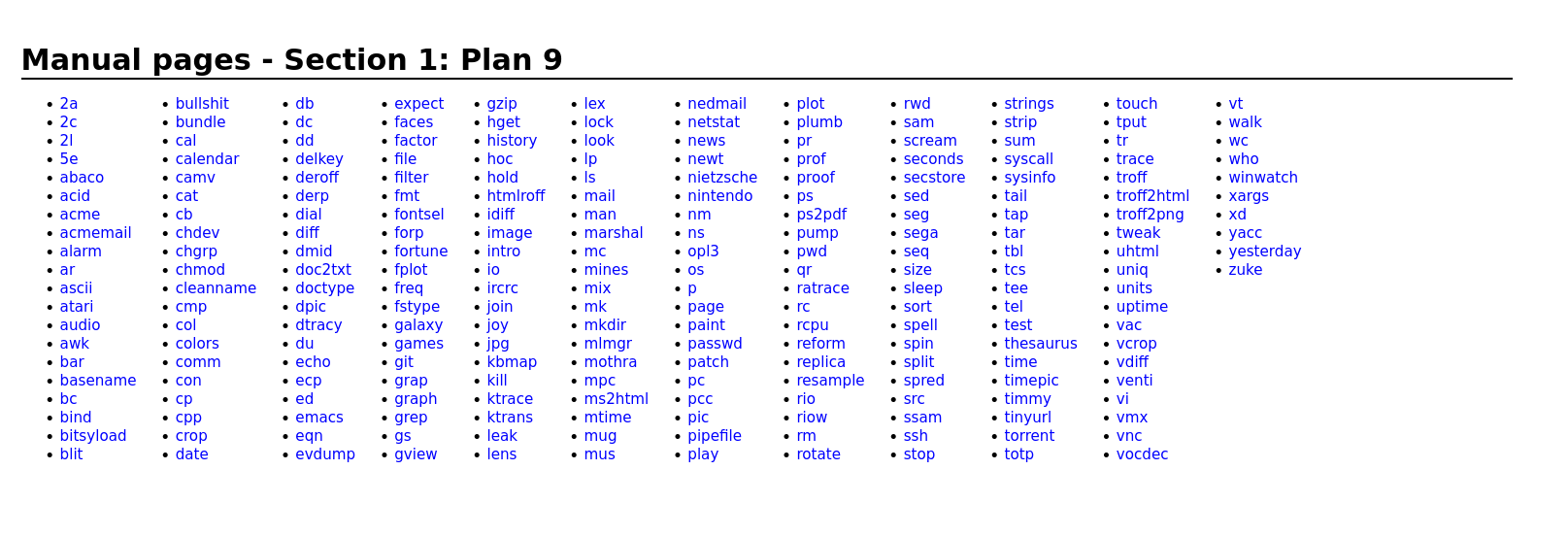
I recommend everybody read the 9front manual.
I haven’t managed to get past their home page yet, it just looks like an inside joke.
After glancing at the manual, I now know I was previously correct stopping at the home page
It’s OK, 9 front isn’t right for everybody.
For instance, it is not for me.
I enjoyed the manual though.
8 butt is probably more my style
The manual, section 1:
Why don’t kde? Are they also into AI slop? I didn’t used elementaryOS yet. Is elementaryOS a good daily driver? Also what about Arch?