You must log in or register to comment.
It’s kind of weird that one dude could get hit by a bus and suddenly billions of devices would stop getting timezone updates.
What’s missing in this article (or at least as much of it as I could read) is that much of the software listed has alternatives. For instance, bash can be replaced by a combination of some other shell (fish, zsh, dash . . .) and some other scripting language (python, perl . . .). There are other compression algorithms than xz, even if they’re less efficient. And so on.
Others are nice-to-haves, but their absence wouldn’t cause much actual technical dysfunction. If Harfbuzz vanished tomorrow, it would result in some ugly text displays. This is not the end of the world.
tl;dr: it’s about the timezone database (edit: among other projects) which is “maintained by a group of volunteers. Originally founded by Arthur David Olson, the project is now led by Paul Eggert and Tim Parenti.”
I know that this usually comes down to one person doing a lion’s share of the work. This applies to so many FOSS pojects, especially when their impact bleeds over into the non-FOSS world (and by now I think we can include Android in that). Yet the world of FOSS has never broken down even when one of these "one person"s quits. We know. But it might be scawy for people who live in proprietary la-la-land.
Don’t get me wrong, this is important. But I find the article with all its dark javascript magic a little hyperbolic, sensationalist. Even the “plain” reading page is. Gigantic headers, large numbers etc.
I will also add that the tz database isn’t huge, and it isn’t prone to constant change. It makes for great numbers but the whole issue is pretty pedestrian if you look a little closer.How many parts of closed systems that many people rely on are maintained by only 1 person (who would promptly be replaced by corporate if they quit)? I guess we just don’t have so much data on that because - surprise - they’re not Open.
I could’ve written a similar article, but I would have written it differently.
edit: I stand corrected on the crossed-out bit.
I’ll also state very clearly that I agree with the topic, just not the way it is presented.
And that I was fully aware that this is not only about the TZ databse when I wrote this.It’s good to highlight the efforts of some of the little keystones that are all too easily overlooked. The deeper you dig the more you realize there are more people silently doing their job that makes anything else we do on the internet even possible. Millions of people all over the world, invisible to you on a normal day, doing things you only have the vaguest awareness of making every moment of every day possible to begin with. Offline too if you want to get technical. The intricate web of civilization is humbling when you think about it.
When I scrolled through only the first bit was about tzdb, it also talked about bash, libxml, libz, curl, TrueType, Harfbuzz, SQLite, and I think more.
Not sure why your copy only has the first section.
deleted by creator
No, you either didn’t read the full article or you’re misrepresenting it.
Sometimes Reader mode only pulls the intro to the article; paywalls and ad loads sometimes stop full text from being initially loaded in order to prevent bots/scrapers and unpaid/as blocking readers from accessing the full work.
EDIT: Doesn’t seem to be the case here with iOS Reader Mode on Voyager’s builtin browser. I haven’t tried other browsers.
Well, related to time, the one guy who maintained Linux NTP client/server almost had to stop doing it and go get a job a couple years ago.
These projects are important, and while the article is a bit dramatic, I would argue that the folks doing work like writing IEEE specs and the drudgery of IANA cleanup are what keep the internet from being any shittier than it already is.
It is prone to constant change. Any time an area decides to change time zones, or adjust DST dates, that requires a tzdata update.
It can get geopolitically complex, too, because if a country invades a neighbor and tells them to start using the invader’s time zone, should tzdata reflect that, even though it’s illegal?
251 changes in a year does in fact sound like ‘ constant change’ to me. And there were 9 other projects discussed!
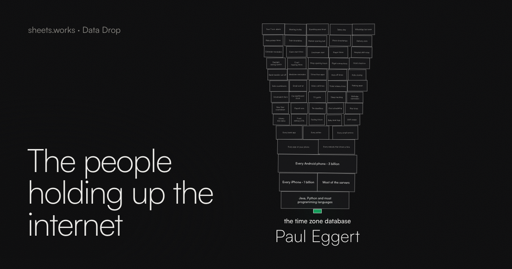
Looking at the inverted pyramid thing, that’s not really the Internet. That’s whatever that fish bowl network smartphones use.
That would be the Internet. POTS was replaced a long time ago, pretty much all cell towers use a fiber backhaul now.
Kind of but smartphones are still in their own little universe. I don’t buy a website from a store like it’s a word processor and install it on my desktop. And that pyramid is specifically focused on phones and how they all interconnect. Laptops and desktops aren’t even mentioned. Using the Internet on a phone is way different than using it on a desktop. It’s like swimming in a bathtub.
They really aren’t but I am also not following how things like “every website that shows time” has anything do do with phones.
I think the disconnect may be due to the article repeatedly mentioning that “this stuff is used by smartphones/websites!!!” but almost never mentioning that full-sized computers exist, even though most of the software being discussed is Linux-primary (and some of it is also used on Windows/Mac, like SQLite). It looked to me like the author’s target audience was “people who use a smartphone as their primary or only device.”
Most of the software mentioned in the article runs on most devices.