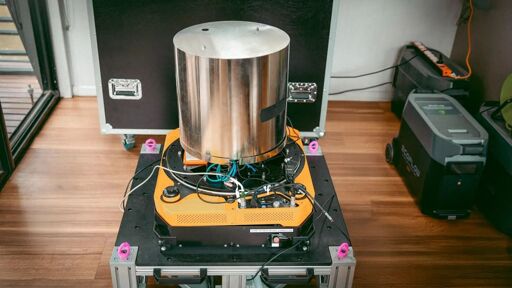
Using quantum sensors, the company achieved ten times the accuracy of conventional satellite-based navigation systems, while maintaining the one nautical mile positioning accuracy.
Don’t we use GPS accurate to within centimeters for construction?
Yes and no. They often use GPS assisted by beacons. Those beacons are often set up using both high quality GPS but also surveying tools, and you might have seen markers in the ground on cities which was placed using very well calibrated tools so it has a well known very precise precision. Those beacons are easier to track for other machinery because they are so much closer so the radio signal is much clearer and angular precision is much better
I’ve played with GPS from several different directions. There are a lot of GPS receivers on the hobby electronics market that will offer that level of precision, but not accurately. The aviation wide area augmentation system significantly increases accuracy to the point it can be used for precision instrument approaches.
High-end dual-frequency receivers ($$$) can do this, yes. But the earth’s magnetic field is not controlled by any government or military entities. This is pretty big


Don’t we use GPS accurate to within centimeters for construction?
Yes and no. They often use GPS assisted by beacons. Those beacons are often set up using both high quality GPS but also surveying tools, and you might have seen markers in the ground on cities which was placed using very well calibrated tools so it has a well known very precise precision. Those beacons are easier to track for other machinery because they are so much closer so the radio signal is much clearer and angular precision is much better
I’ve played with GPS from several different directions. There are a lot of GPS receivers on the hobby electronics market that will offer that level of precision, but not accurately. The aviation wide area augmentation system significantly increases accuracy to the point it can be used for precision instrument approaches.
High-end dual-frequency receivers ($$$) can do this, yes. But the earth’s magnetic field is not controlled by any government or military entities. This is pretty big
Gravitational field. There’s no way you could achieve this with the magnetic field.
I see what you mean. Yeah that’s pretty cool then. And I guess it might be impossible to jam quantum GPS.
Username checks out.
Not a single gps but multiple, the same trick could be done with this theoretically